A small thermal town.
In the Province of Asti, fourteen kilometres from the city, inside the Nizza DOCG.
A working agricultural town.
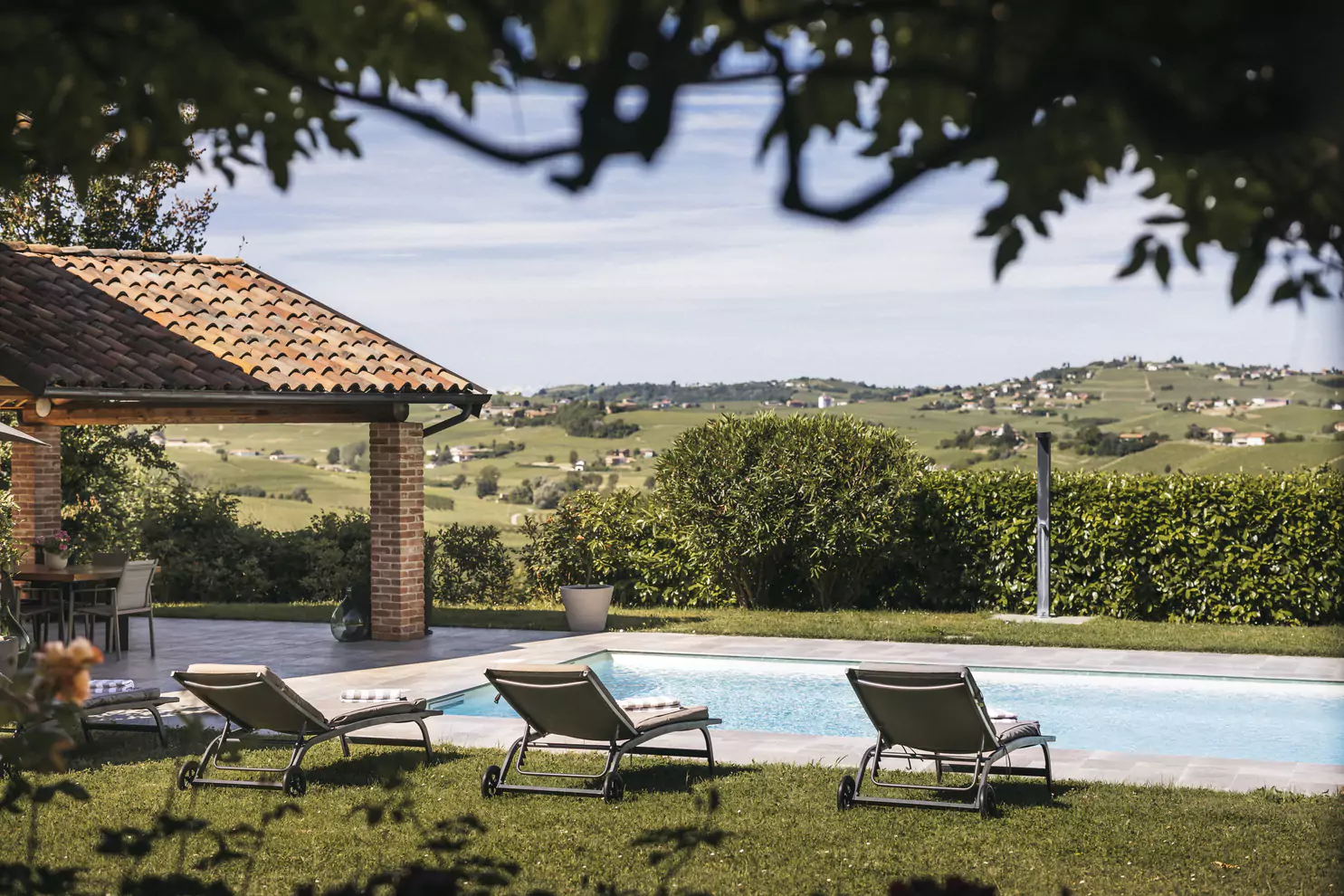
Agliano Terme is a small agricultural town in the Province of Asti — the kind of place where the week is structured around the harvest rather than the tourist season. The landscape is UNESCO World Heritage: rolling vine-covered hills that change colour from the deep green of summer to the copper and gold of October.
The town takes its name from thermal springs that have been used since the eighteenth century. The pace is agricultural. The best time to arrive is September, when the harvest begins.
Found in a field, 1770.
The water surfaced in 1770, in a field above the village. The reading is salsobromoiodic — sulphur, iodine, and bromine — and the smell carries before you see it. Through the nineteenth century, families came up from Liguria and Turin to passar le acque: take the cure for a fortnight, then leave again.
The hotel built around the spring opened, closed, and reopened. An inhalation centre arrived in 1985. The village formally added Terme to its name in 1991. The current facility on Via alle Fontane — Fons Salutis — opened in 1999. The waters are still listed; the smell still carries.
Fourteen kilometres from Asti. The road climbs the last three.
Eighteen villages, one grape.
Agliano is one of eighteen communes that share the Nizza DOCG — the only Italian DOCG reserved exclusively for Barbera. The designation split off from Barbera d'Asti in 2014, after the producers argued for a higher tier with stricter rules: hillside fruit only, lower yields, eighteen months of ageing, six of them in wood.
Within those eighteen villages, Agliano sits on the north-western edge, on the lighter sandy marls. Wines grown here tend toward aromatic precision rather than weight — Barbera with the lift left in. The producers' association is in the process of forming its own consortium, separate from Barbera d'Asti. By the next vintage on the shelf, the label may stand alone.
Frederick II met her here.
Around 1225, Frederick II of Swabia met Bianca Lancia at the castle in Agliano. Their son Manfredi became King of Sicily and was killed at Benevento in 1266 — Dante places him in Purgatorio III, recognised by his father's blond hair.
The castle is gone, destroyed in the Wars of Monferrato Succession. The story remains on a plaque in the village and in the books of medieval Piedmont.
A car is useful. The roads are quiet.